Définition en anglais : wall
/wɔːl/ 1. a continuous vertical brick or stone structure that encloses or divides an area of land.
2. a thing regarded as a protective or restrictive barrier.
verb enclose (an area) within walls, especially for protection or privacy.
3. a strucutre that isolates, separates, or serves as a boundary.
4. an obstacle formed by people or things acting to oppose or resist.
5. an obstacle to communication or understanding between people.
The concept of wall holds several possible and existant meanings within the understanding of the subject. Fundamentally, the definition of a wall is an artificial vertically, a standstill, sometimes imaginary construction that serves to separate, support, protect, limit, ensure privacy, or define a home,...
The functions provided by a wall, or a series of such surfaces, enable humans to visualize a space and establish themselves within it.
Constructing walls allows for the protection of an indoor place, preserve an intimate and personal place, occupy a room, a space or a parcel to live in a property or a share space.
The wall can carry symbolic significance and possess immense physical or imagined proportions, reflecting a state of mind, an ambition, or a message.
 The concept of protection :
To defend against any harm : against danger, injury, or risk. To shield from attack, mistreatment, or danger. The act of protecting or preserving.
A wall can serve a protective function, providing a secure place within a space shielded from threats and ensuring safety. To assure its survival, a living being must manage to escape death and, consequently, find ways to minimize risk. Fortified walls built to protect a space, a population, or a treasure (an object of value) serve a defensive purpose.
The notion of property :
the right to dispose of a property, sovereignty over the object to the exclusion of any other person, subject to laws and regulations.
A wall can divise as an impassable barrier, or a fortified structure restricting access to any individual.
Defending a property with built structures to keep out other human blocks horizons, passages, mutual exchanges and by consequence it restricts communication.
Overprotecting one's wealth can lead to a refusal to share, a sense of mistrust, and an attitude of excessive attachment to one's possessions.
Questioning : At what point is a piece of land considered to belong to an individual (care and attention devoted to productive labor on the land, inheritance, duration of occupation, etc.) ?
The concept of property is linked with the capitalist system : In capitalist ideology, agricultural fields and lands that were originally accessible and held in common became private property (openfields to enclosure). Fields were once "open", free to use for people, but during the Industrial Revolution, and in order to boost agricultural productivity to meet the alimentary needs for a rapidly growing urban population, enclosure systems were developed. These systems allowed for greater control over cotton plantations and sheep (specifically for harvesting wool to manufacture clothing textiles) and served to expand the fabric trade and commercial exchange.
Walls as a closed center :
Closed center : a place where entities are gathered at a single point from which they cannot escape.
Closed centers defined by enclosing walls can foster isolation, thereby increase fears regarding other human beings. Under state-established laws, penal institutions, such as prisons, aim to physically and socially distance individuals judged dangerous, deviant, or uncivil from society. Incarceration can give rise to power dynamics and hierarchies, and may at times lead to dehumanization.
The wall as space :
Space : an expanse that does not obstruct movement. An ideal medium in which perceptions are situated. System of reference, framing.
The wall is a vertical space with two distinct sides that can be interpreted as inside and outside. These surfaces serve multiple functions ; for instance, they can be used for displaying, hanging, supporting, exhibiting,...
China's dazibao : dazibao (traditional : 大字報, simplified : 大字报, pinyin : dàzìbào, literally « large characters newspaper ») is a handmade poster made by a citizen, about a political or moral subject, and plastered on walls to be seen by a large audience.
Non-official plastered poster in a public space :
The concept of protection :
To defend against any harm : against danger, injury, or risk. To shield from attack, mistreatment, or danger. The act of protecting or preserving.
A wall can serve a protective function, providing a secure place within a space shielded from threats and ensuring safety. To assure its survival, a living being must manage to escape death and, consequently, find ways to minimize risk. Fortified walls built to protect a space, a population, or a treasure (an object of value) serve a defensive purpose.
The notion of property :
the right to dispose of a property, sovereignty over the object to the exclusion of any other person, subject to laws and regulations.
A wall can divise as an impassable barrier, or a fortified structure restricting access to any individual.
Defending a property with built structures to keep out other human blocks horizons, passages, mutual exchanges and by consequence it restricts communication.
Overprotecting one's wealth can lead to a refusal to share, a sense of mistrust, and an attitude of excessive attachment to one's possessions.
Questioning : At what point is a piece of land considered to belong to an individual (care and attention devoted to productive labor on the land, inheritance, duration of occupation, etc.) ?
The concept of property is linked with the capitalist system : In capitalist ideology, agricultural fields and lands that were originally accessible and held in common became private property (openfields to enclosure). Fields were once "open", free to use for people, but during the Industrial Revolution, and in order to boost agricultural productivity to meet the alimentary needs for a rapidly growing urban population, enclosure systems were developed. These systems allowed for greater control over cotton plantations and sheep (specifically for harvesting wool to manufacture clothing textiles) and served to expand the fabric trade and commercial exchange.
Walls as a closed center :
Closed center : a place where entities are gathered at a single point from which they cannot escape.
Closed centers defined by enclosing walls can foster isolation, thereby increase fears regarding other human beings. Under state-established laws, penal institutions, such as prisons, aim to physically and socially distance individuals judged dangerous, deviant, or uncivil from society. Incarceration can give rise to power dynamics and hierarchies, and may at times lead to dehumanization.
The wall as space :
Space : an expanse that does not obstruct movement. An ideal medium in which perceptions are situated. System of reference, framing.
The wall is a vertical space with two distinct sides that can be interpreted as inside and outside. These surfaces serve multiple functions ; for instance, they can be used for displaying, hanging, supporting, exhibiting,...
China's dazibao : dazibao (traditional : 大字報, simplified : 大字报, pinyin : dàzìbào, literally « large characters newspaper ») is a handmade poster made by a citizen, about a political or moral subject, and plastered on walls to be seen by a large audience.
Non-official plastered poster in a public space :

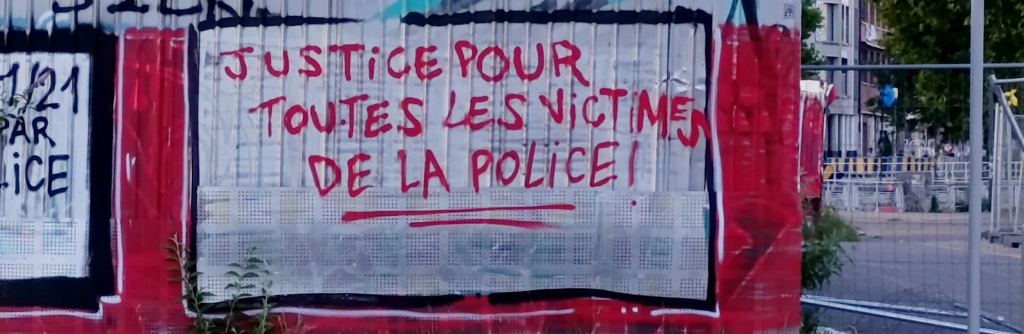
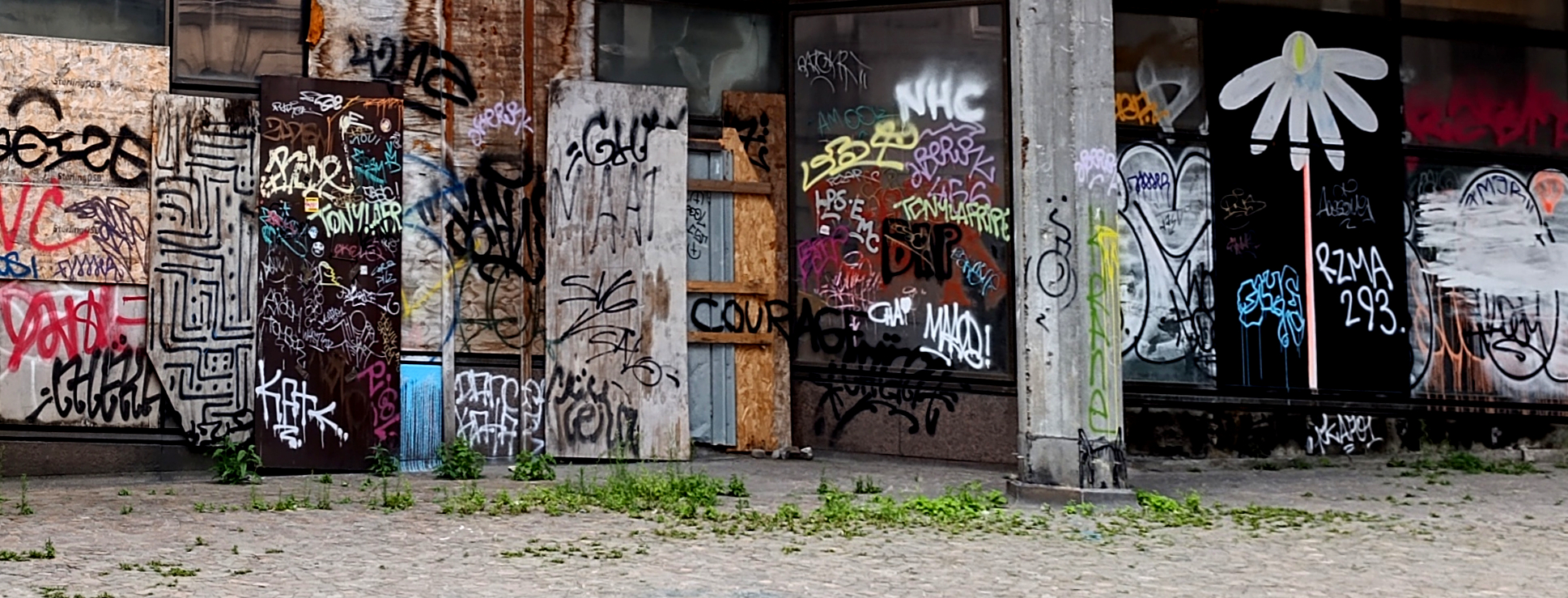
 The wall can be social expression place : in the domain of social media development, Facebook named "wall" the place in the profil where you could express yourself online. The walloftext.co is a project of a wide flexible web page (without size restriction) which allows users to write all together on an online web page. In urban environments, walls are painted, covered and plastered with stickers sometimes, flyers, drawings, posters, letters... witnessing the passage of wanderer and their willingness to leave a trace in public spaces. In urban and rural places, walls are omnipresent. The presence of these surfaces can become spots for displays, such as advertising, political messages or artistic manifestations.
In the music domain, the wall of sound, also named "soundsystem" is a audio phone system built in festive and social events.
The wall in the revolution :
Popular protest movements have elaborated techniques to protect and counter attacks and oppression tentatives from authoritarian government. Creating "blocks", barricades, blockages to forbid traffic mobility and to impose a strike in order to halt economy of a state, to protect zones (ZAD, or ZtD = Zones fo Defend) and protect lives.
"You can't stop dancing people": the wall of sound : or "sound system", has brought together people, groups of friends, social outsiders in underground communities for "free parties" or "raves." These events are organized without ticket sales or security checkpoints, aiming to foster freedom, free access, and mutual respect among participants.
In political history :
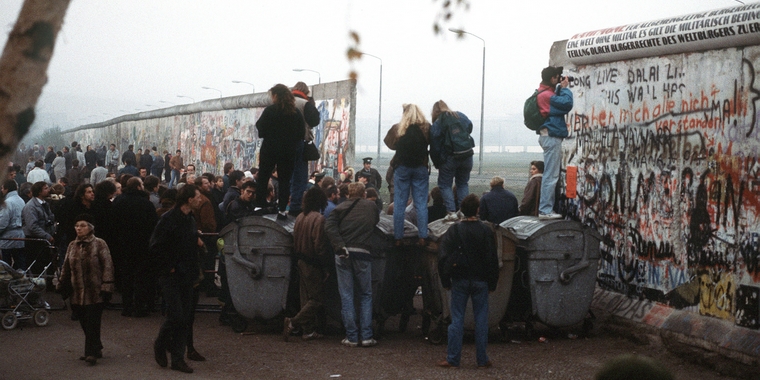
The Planck wall, the Great Wall of China (over 300 years old ; a military project symbolizing power and deterrence, used strategically), the Berlin Wall, the Iron Curtain, the Wailing Wall, firewalls, "Sois mur" (a housing slogan), the US-Mexico border barrier, Saudi Arabia's construction (2006) of a fortified wall along its border with Iraq, the Green Line in Cyprus, the Israeli separation barrier in the West Bank, the Korean Demilitarized Zone...
The concept of wall in media and communication :
The "editorial wall" is a barrier separating advertisers from editorial staff ; it prevents cross-influence between the two functions, thereby guaranteeing editorial independence unaffected by the media outlet's financial needs.
The wall can be social expression place : in the domain of social media development, Facebook named "wall" the place in the profil where you could express yourself online. The walloftext.co is a project of a wide flexible web page (without size restriction) which allows users to write all together on an online web page. In urban environments, walls are painted, covered and plastered with stickers sometimes, flyers, drawings, posters, letters... witnessing the passage of wanderer and their willingness to leave a trace in public spaces. In urban and rural places, walls are omnipresent. The presence of these surfaces can become spots for displays, such as advertising, political messages or artistic manifestations.
In the music domain, the wall of sound, also named "soundsystem" is a audio phone system built in festive and social events.
The wall in the revolution :
Popular protest movements have elaborated techniques to protect and counter attacks and oppression tentatives from authoritarian government. Creating "blocks", barricades, blockages to forbid traffic mobility and to impose a strike in order to halt economy of a state, to protect zones (ZAD, or ZtD = Zones fo Defend) and protect lives.
"You can't stop dancing people": the wall of sound : or "sound system", has brought together people, groups of friends, social outsiders in underground communities for "free parties" or "raves." These events are organized without ticket sales or security checkpoints, aiming to foster freedom, free access, and mutual respect among participants.
In political history :
The Planck wall, the Great Wall of China (over 300 years old ; a military project symbolizing power and deterrence, used strategically), the Berlin Wall, the Iron Curtain, the Wailing Wall, firewalls, "Sois mur" (a housing slogan), the US-Mexico border barrier, Saudi Arabia's construction (2006) of a fortified wall along its border with Iraq, the Green Line in Cyprus, the Israeli separation barrier in the West Bank, the Korean Demilitarized Zone...
The concept of wall in media and communication :
The "editorial wall" is a barrier separating advertisers from editorial staff ; it prevents cross-influence between the two functions, thereby guaranteeing editorial independence unaffected by the media outlet's financial needs.